
Open Doors 2026: What International Students Mean for Washington
Every November, the Open Doors report takes stock of international students in the U.S. and U.S. students abroad. This year’s data, released this week, tells a story about what international students bring to Washington, and what’s at risk.
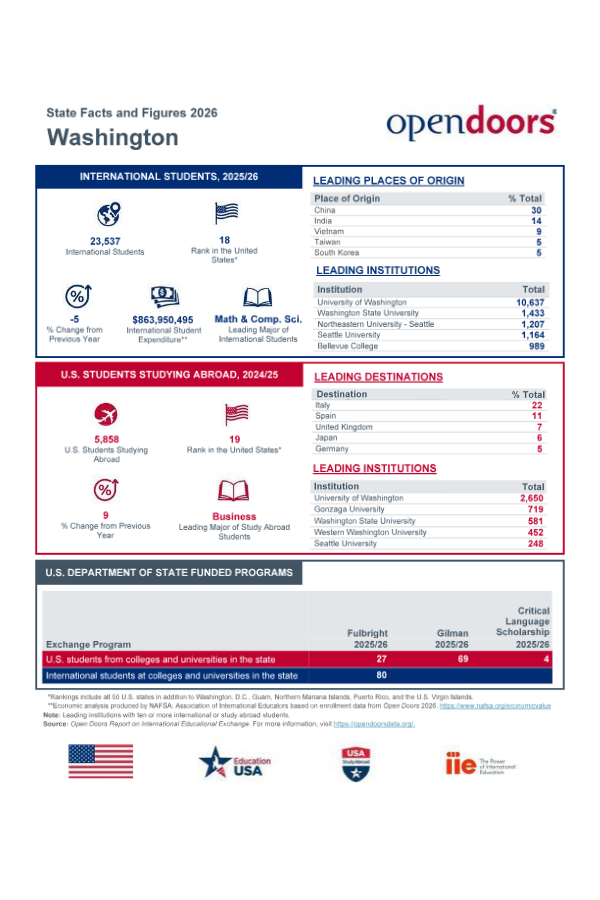
In 2025/26, 23,537 international students studied at Washington colleges and universities, making our state 18th in the nation. They come from more than 100 countries, but the leading countries of origin are China, India, Vietnam, Taiwan, and South Korea. The University of Washington hosts the most, with 10,637, followed by Washington State University (1,433), Northeastern University-Seattle (1,207), Seattle University (1,164), and Bellevue College (989).
The impact of international students in our state reaches well beyond campus. NAFSA’s economic analysis of the Open Doors data estimates that international students spent nearly $864 million in Washington this year. That is spending on tuition, rent, groceries, transportation, and everything else it takes to live here. It adds up to a real source of support for neighborhoods, small businesses, and institutions across the state.
But the numbers are moving in the wrong direction. Washington’s international student population fell 5% from last year. Nationally, the total dropped 2.7% to 1,146,163 students, and new international enrollment fell a sharp 17.7%, to 228,123. Graduate enrollment, the largest group, declined 13.4%. That is a real loss for our communities, and one we will feel for years to come.
The exchange also runs both ways, and the outbound numbers are encouraging. In 2024/25, 5,858 Washington students studied abroad, up 9% from the previous year, and nationally study abroad grew 5% to nearly 314,000 students. Young people clearly want global experiences. Still, only about one in ten U.S. undergraduates studies abroad during college. For those who don’t choose study abroad, their closest encounter with the world often happens at home, through international students in their classrooms and communities. When fewer international students come here, those students lose that opportunity.
At FIUTS, we see the value of international education every day, in friendships formed at our events, in classrooms where students share their lives and cultures, and in the families who welcome students into their homes. The Open Doors data reminds us that this work matters economically as well as personally, and that it needs our continued support.
Explore the full data at opendoorsdata.org.